Why GRC Programs Fail (And How NIST Security Lifecycle Fixes It)
Four-phase closed-loop security program using NIST CSF 2.0. From risk assessment to continuous improvement—with real test case evidence proving it works.
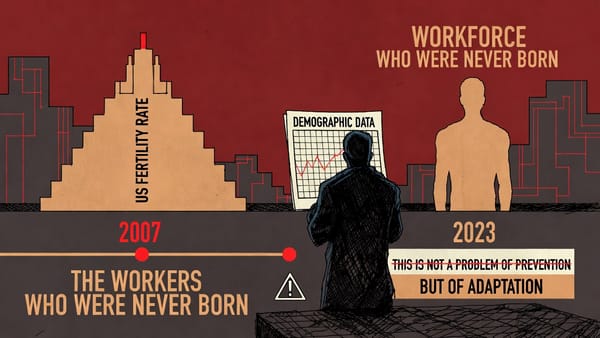
US fertility fell below replacement in 2007. The workers who would sustain our economy were never born. We're not preventing a crisis - we're adapting to one.
Why I chose 'adjacent' over 'augmented' and what it means for human-AI collaboration. The philosophy behind the framework.
A deep dive into the Intelligence Adjacent framework - from hierarchical context loading to VPS-deployed security tools. Every component explained.
A comprehensive audit revealed systemic architectural problems in the IA framework. Here's what patterns worked consistently, what caused failures, and why a complete rebuild is the only viable path forward.
Professional web application security testing using OWASP Top 10, WSTG, ASVS, and API Top 10 as an integrated methodology - not just a checklist.
Quality penetration testing at a fraction of the cost. AI-assisted security assessment with rigorous scope compliance, impact-driven prioritization, and professional deliverables.
Four-phase closed-loop security program using NIST CSF 2.0. From risk assessment to continuous improvement—with real test case evidence proving it works.
Why bigger context windows don't mean better results. A three-layer architecture that loads only what's needed, when it's needed.
After months of debugging agent routing failures, we discovered the real problem wasn't our code—it was our enforcement strategy. Here's what we learned.
The most sophisticated code in your codebase might be the most expensive to maintain. Here's why deleting clever components often improves everything.
Agents under 150 lines that route to specialized skills. Identity and routing, not implementation.
How a 5-tier documentation architecture enables consistent, discoverable slash commands. Build once, reuse forever.
Specialized skills with progressive context loading. Load only what you need, when you need it.
Every framework says '43 tools' and becomes wrong the moment you add tool 44. Here's a controversial but practical solution: ban all hardcoded counts.
Building an LLM-agnostic architecture where model selection is a feature, not an accident. Five models, each with a role, ready for whatever comes next.