2026 Predictions: The Year We Stop Pretending
From AI anxiety to career stagnation, 2026 marks the year of accountability—when job market predictions, education disruption, and mental health trends converge into a reality check.

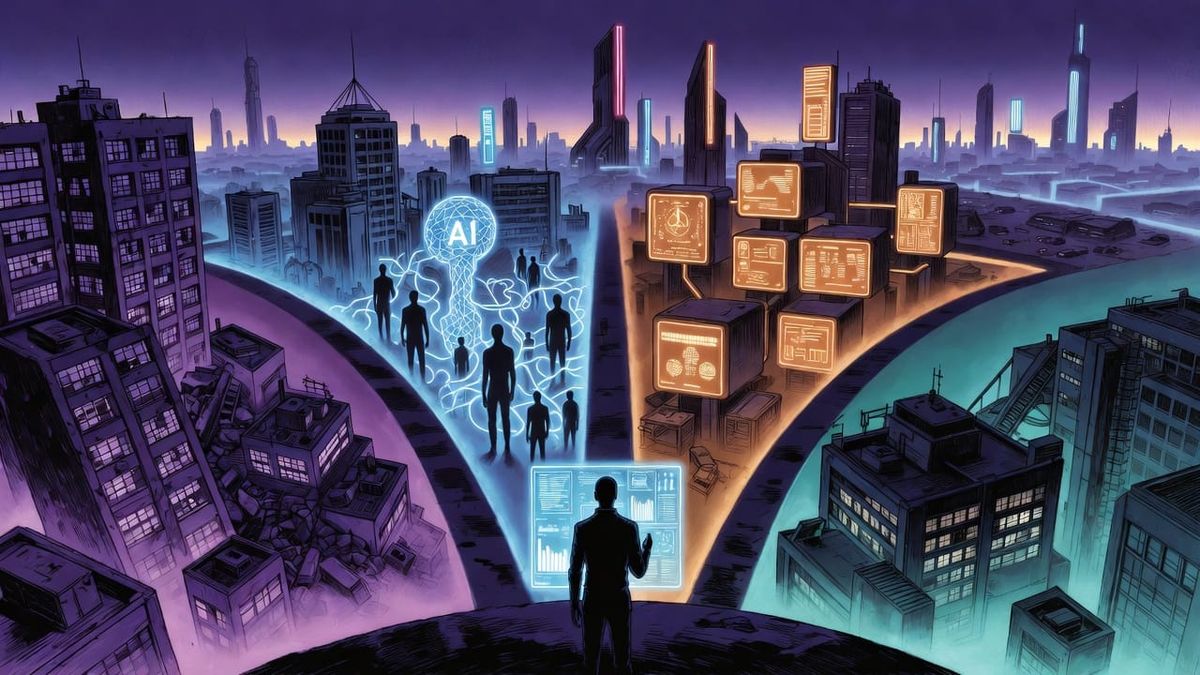
What if 2026 isn't the year things fall apart—but the year we finally admit they're not working?
I've spent the last weeks digging through economic forecasts, labor market reports, education data, and mental health statistics. The pattern is clear: 2026 is when the bill comes due for decisions made between 2020 and 2025. We experimented with remote work, rapid AI adoption, alternative credentials, and new workplace models. Now we measure the results.
And the results aren't pretty.
This isn't pessimism. It's realism based on data from JPMorgan, the IMF, Fitch Ratings, and leading research institutions. Here's what the numbers tell us about the year ahead.
Job Market: The "Low-Hire, Low-Fire" Trap
The 2026 labor market outlook can be summarized in three words: stuck in place.
JPMorgan forecasts modest job gains for Q1 2026 at approximately 57,000 net-new jobs per month—significantly slower than recent years. Unemployment is expected to peak at 4.5% in early 2026. On the surface, that seems manageable. Low unemployment, right?
Wrong. This is what labor economists call a "low-hire, low-fire" market. Companies aren't laying people off en masse, but they're not hiring either. Economic uncertainty over tariffs, generative AI, and policy changes has made employers hesitant to commit.
For workers, this creates a hidden crisis: millions stuck in roles they've outgrown, unable to move. Career mobility is dying.
The Entry-Level Crisis
The numbers get worse for new graduates. Employers are projecting just a 1.6% increase in hiring for the Class of 2026 compared to 2025. That's essentially flat growth.
Entry-level positions are becoming the most competitive segment of the job market. Companies are hiring fewer new graduates, creating an experience gap that compounds over time. If you can't get your first job, you can't build experience. Without experience, you can't compete for better roles. The gap becomes permanent.
Where Growth Exists
Not all sectors are frozen. Five areas stand out for job growth:
- Healthcare and social assistance - Driven by an aging population and demand for outpatient and home-based care
- Technology roles - AI and cybersecurity specialists
- Clean energy and electric vehicles - Emerging sector growth
- Construction and infrastructure - Ongoing infrastructure investments
- Advanced manufacturing - Particularly the semiconductor sector
The pattern is clear: workers with specialized skills in these areas will find strong demand. Everyone else faces increasing competition for fewer opportunities.
AI Impact: From Hype to Reality Check
2026 is being called the year AI evolves from instrument to partner—transforming how we work, create, and solve problems. That sounds optimistic until you dig into what "partner" actually means for employment.
The Displacement Data
Geoffrey Hinton, the "Godfather of AI," now warns that AI will replace many jobs beyond call centers in 2026 and beyond. This from the person who helped build the technology.
The World Economic Forum projects 83 million jobs lost and 69 million created by 2027—a net loss of 14 million jobs. Enterprise VCs are predicting big impact on the workforce in 2026, with budgets shifting from labor to AI.
Here's what that looks like in practice: workers accomplishing tasks more quickly through automation. Tasks that previously required human workers being automated. Companies hiring fewer entry-level workers. The lowest rungs of the corporate ladder experiencing displacement first.
The Anxiety Loop
The mental health data reveals something troubling: 47% of U.S. adults feel anxious about job security due to AI, while 48.7% have used AI language models for psychological support in the last year.
Read that again. People are leaning on the technology making them anxious to help them cope with the anxiety it's creating. That's not a paradox—that's 2026.
From Experimentation to Implementation
The shift happening in 2026 is from AI exploration to AI accountability. Companies spent 2022-2025 experimenting with AI tools. In 2026, they're measuring ROI and making budget decisions. When the choice is between a human salary and an AI subscription, the math isn't complicated.
AI agents are being positioned as "digital coworkers"—a three-person team can launch a global campaign in days, with AI handling data crunching, content generation, and personalization while humans steer strategy and creativity. That sounds empowering until you realize it means teams don't need to hire a fourth person. Or a fifth. Or a sixth.
Education: The Credential Collapse
The demographic cliff facing higher education isn't news. What's new is that it's coinciding with three other crises simultaneously: federal funding cuts, ROI scrutiny, and AI-powered student recruitment bypassing institutions entirely.
The Perfect Storm
2025 marked the high-water mark for traditional-aged undergraduates. From 2026 forward, institutions face sustained and irreversible decline in their core market.
Fitch Ratings issued a "deteriorating" outlook for the higher education sector in 2026 based on:
- Shrinking prospective student base
- Rising uncertainty related to state and federal support
- Continued expense escalation
- Shifting economic conditions
The number of colleges merging or closing is expected to continue at an elevated pace.
Federal Policy Changes
The One Big Beautiful Bill Act enacted significant reforms that reduce access to student funding. Grad PLUS loans are being phased out, with lifetime borrowing caps set at $100,000 for most graduate students and $200,000 for professional degrees.
This isn't just reducing access—it's forcing students to reconsider whether higher education makes financial sense at all.
Alternative Credentials Rising
While degree enrollment falls, certificate earners grew by a record 11% year over year. With Workforce Pell arriving in 2026, momentum is tilting toward certificates and non-degree credentials.
Institutions that lean into dual enrollment, high-quality non-degree credentials, and demonstrable workforce outcomes will be better positioned. Those clinging to traditional four-year degree models will struggle.
AI Disrupting Recruitment
Colleges built their business models on controlling information flow to prospective students. AI broke that monopoly.
Modern learners are using AI-powered tools to search, compare, and evaluate schools before ever reaching an institution's website. The student journey is now self-directed, hyper-personalized, and constantly evolving. Institutions have lost control over the early stages of the recruitment funnel.
Students can comparison-shop degrees like products. And increasingly, they're choosing "no degree" as the smart option.
Workplace: The Hybrid Creep
Remote work isn't being killed by a single mandate—it's dying through incremental erosion.
The Numbers Behind the Shift
Currently, 64% of leaders report their companies use a hybrid model, with 80% of remote-capable employees working hybrid (52%) or fully remote (26%).
But the trend is moving in one direction. By 2026, companies requiring full five-day office attendance are expected to rise to 30%, and nearly half of all companies plan to require employees in the office four days a week or more.
This is boiling-frog strategy. Each incremental change feels small enough to accept. By 2026, "hybrid" has been redefined from "mostly remote with some office days" to "mostly office with WFH Fridays."
The Employee-Employer Divide
The disconnect between employee preferences and employer mandates is stark:
- 83% of workers feel more productive in remote/hybrid than on-site
- 55% want to work remotely at least three days per week
- 85% say remote work matters more than salary when evaluating jobs
Yet companies are pulling back. 40% of U.S. workers would accept 95% or less of their current salary for the option to work remotely. Among tech workers, many are willing to accept 25% lower salaries for hybrid or remote roles.
Flexibility has become currency. But employers increasingly aren't selling.
Long-Term Trajectory
By 2030, nearly 40% of the global workforce is expected to operate in remote or hybrid setups. But 2026 is when companies solidify their long-term work models. The split is becoming clear: some embrace flexibility as competitive advantage, others push office returns as cultural priority.
Workers who negotiated remote arrangements in 2020-2022 are losing ground annually.
Well-Being: Anxiety as Economic Data
For the first time, mental health statistics are being tracked with the same rigor as unemployment and GDP. That's not because we suddenly care more—it's because deteriorating mental health is now recognized as an economic drag measurable in trillions of dollars.
The Mental Health Baseline
More than one in three Americans (38%) plan a mental health-related resolution for 2026, up 5% from last year. Mental health now ranks as the third top priority for Americans, after physical fitness (44%) and financial goals (42%).
Looking back on 2025, 63% rated their mental health as excellent or good. But 28% said it was fair and 8% said it was poor. Americans report feeling anxious about personal finances (59%), uncertainty about the next year (53%), and current events (49%).
Workplace as Mental Health Driver
The workplace has become the primary driver of mental health trends. 84% of employees reported at least one mental health challenge in the past year, with 57% experiencing moderate to high levels of burnout.
This isn't a minority struggling—it's the default state.
The Plateau Effect
Data has shifted from the acute "spikes" of the early 2020s to a sustained, complex "plateau." We're not recovering from COVID-era mental health challenges. We've settled at a permanently elevated level of distress.
When mental health becomes a top-3 national priority alongside physical health and money, it's no longer a "wellness" issue—it's an economic survival issue.
Skills Gap: Continuous Learning or Continuous Obsolescence
The half-life of expertise is shrinking. With AI automating entry-level work and specialized roles exploding in complexity, the middle is collapsing.
The Productivity Cost
$11.5 trillion in global productivity is lost annually due to skills gaps. Additionally, 81% of organizations are dealing with technology skills gaps.
This isn't a talent pipeline problem—it's a velocity problem. The pace of technology change has outstripped the ability of traditional training programs to keep up.
The Skills Divide
The most in-demand skills in 2026 combine technical and human capabilities:
Technical skills rising fastest:
- AI and machine learning
- Data analytics
- Cybersecurity
- Cloud computing
- Green technologies
Human skills equally critical:
- Leadership
- Emotional intelligence
- Adaptability
- Judgment and decision-making
Meanwhile, routine skills are declining: data entry, basic accounting, telemarketing, customer service, administrative support—all being automated.
Upskilling Economics
89% of organizations report that upskilling is more cost-effective than hiring new talent. Yet skills gaps continue widening. Why?
Because static training programs can't keep pace with technology change. The new model is real-time, AI-driven learning that adapts to business needs daily. If you're not learning continuously, you're becoming obsolete continuously.
Skills-Based Hiring
65% of employers have adopted skills-based hiring practices for entry-level positions. This shift from credential-based to competency-based hiring should be good news. In practice, it raises the bar. You need to demonstrate skills, not just show a diploma.
The Unifying Theme: Accountability Era
The common thread across job markets, AI adoption, education, workplace models, and skills is that 2026 is when every institution gets asked "what value do you actually provide?" and platitudes no longer suffice.
Everything Must Justify Its ROI
Evidence of the accountability shift:
- Higher ed facing program-level outcome metrics (first-year earnings, job placement rates)
- Skills-based hiring replacing credential-based hiring
- Companies requiring measurable AI ROI, not just experimentation
- Workers demanding remote work based on productivity data
The 2020s began with crisis accommodation. We accepted emergency policies, remote work experiments, online learning pivots. 2026 is when we evaluate what actually worked.
The Opportunity in Accountability
This isn't just grim news. Accountability creates opportunities for those willing to:
- Build demonstrable skills continuously - Not credentials, skills. Not static training, continuous learning.
- Prove value through outcomes - Metrics, results, measurable impact.
- Adapt to permanent evaluation - Every job, every degree, every policy must justify its existence.
- Navigate without institutional guardrails - The old paths aren't reliable anymore.
What 2026 Actually Means
2026 isn't the year everything falls apart. It's the year we stop pretending it's all working.
The job market is frozen in "low-hire, low-fire" stagnation. AI is creating as much anxiety as productivity. Higher education credentials are losing value while remaining expensive. Remote work flexibility is eroding through "hybrid creep." Mental health awareness hasn't translated to improvement. Skills gaps widen despite training investments.
These aren't failures—they're feedback. The systems built for 2019 don't work in 2026. Trying to restore 2019 normal isn't the answer. Building capability for 2026 reality is.
That means:
- Continuous skill development over static credentials
- Outcome-based value over institutional prestige
- Self-directed learning over prescribed programs
- Measurable results over participation certificates
The institutions that recognize this will adapt. The ones that resist will join the list of colleges closing in 2026.
The individuals who embrace accountability will thrive. The ones who wait for the system to fix itself will be left behind.
2026 is when we find out which category we're in.
The Intelligence Adjacent framework is free and open source. If this helped you, consider joining as a Lurker (free) for methodology guides, or becoming a Contributor ($5/mo) for implementation deep dives and to support continued development.
Sources
Labor Market and Employment
- Will the job market improve in 2026? - JPMorgan Insights
- Job Outlook Update: Class of 2026 Hiring Projections - NACE
- 2026 Labor Market Outlook: Stuck in Place - SHRM
AI and Automation
- AI paradoxes: Why AI's future isn't straightforward - World Economic Forum
- Investors predict AI is coming for labor in 2026 - TechCrunch
- 'Godfather of AI' Geoffrey Hinton predicts 2026 job replacement - Fortune
Higher Education
- 6 higher education trends to watch in 2026 - Higher Ed Dive
- Higher education faces 'deteriorating' 2026 outlook, Fitch says - Higher Ed Dive
- 9 Higher Ed Trends Shaping 2026 - Tyton Partners
Mental Health and Well-Being
- More Americans Plan Mental Health Resolutions Heading Into 2026 - American Psychiatric Association
- 8 Mental Health Trends for 2026 and Your Workplace - Spring Health
- Mental Health Statistics 2026: What the Data Tells Us - Favor Mental Health Services
Economic Outlook
- Global Economic Outlook 2026 - Deloitte Insights
- Global Economy Forecast: Sturdy Growth of 2.8% in 2026 - Goldman Sachs
- World Economic Outlook Update, January 2026 - IMF
Workplace Transformation
- Remote Work Trends 2026: How Global Teams Are Reshaping Work - Gini Talent
- 80+ Hybrid Work Statistics in 2026 - Archie
- The Great Return: How 2026 Could Redefine Remote Work - Hampson Properties
Skills and Workforce Development
- Top Skills to Learn in 2026: A Leader's Upskilling Guide - Cornerstone OnDemand
- 33 Key Skills Statistics Every Leader Should Know for 2026 - iMocha
- Workforce predictions for 2026: What leaders should know - General Assembly