The AI Investment Reckoning: No Profits, No AGI, No Plan
OpenAI will burn $143B before turning a profit. AGI has no agreed definition. Data centers are draining aquifers. The architecture has provable limits. The math doesn't work.

The AI industry did something genuinely interesting. Attention mechanisms and transformer architecture are real innovations. Large language models do things that were impossible five years ago. That part is true.
Everything built on top of that observation is a different story.
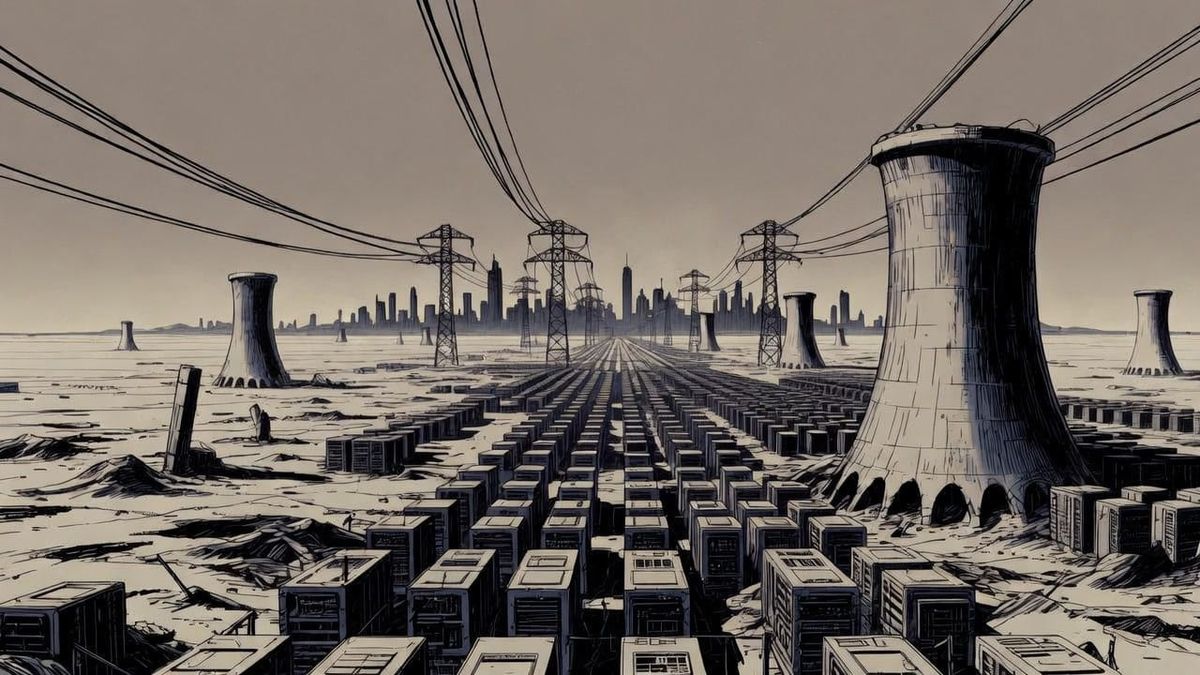
OpenAI will accrue approximately $143 billion in negative cumulative free cash flow between 2024 and 2029 before becoming profitable — if it becomes profitable at all. The company that most loudly promises artificial general intelligence has no agreed definition of AGI, no clear path to profitability, and no architecture that can get there. Meanwhile, data center expansion is draining aquifers, spiking electricity bills, and converting farmland to server farms that employ two dozen people per facility. Communities are organized and pushing back: $64 billion in data center projects have been blocked or delayed in less than a year.
The interesting discovery got leveraged into an investment narrative that cannot support its own weight. What follows is what that looks like in numbers.
No One Is Profitable — And the Math Does Not Work
The clearest way to understand OpenAI's financial position is to look at the ratios, not the revenue headlines.
In 2024, OpenAI spent $9 billion and brought in $4 billion — a $5 billion loss. Half of that revenue went straight to inference compute. Revenue growth, which was running at 250% in 2024, collapsed to 56% in 2025. To reach break-even, the company needs to triple revenue annually through 2030. Financial documents show $74 billion in operating losses in 2028 alone, with positive cash flow not arriving until annual revenue hits $125 billion — projected no earlier than 2029.
Anthropic's numbers are cleaner but not structurally different: $5.3 billion lost in 2024, with break-even projected for 2028. Anthropic's cash burn is 14x lower than OpenAI's. Both still depend on continuous external financing.
The capital commitment picture is what makes the math genuinely alarming. Sam Altman told TechCrunch that OpenAI has $1.4 trillion in data center commitments over the next eight years and plans to build one gigawatt of computing capacity per week at $20 billion per gigawatt. The 2029 projection: $650 billion in infrastructure costs against a $125 billion revenue target. That is a $525 billion annual gap, funded by investors who have been told AGI is imminent.
Enterprise adoption is not closing that gap. Deloitte found that while 85% of organizations increased AI investment, typical ROI payback runs 2–4 years against an expectation of 7–12 months. MIT research cited in that analysis found 95% of enterprise generative AI investment yielding no measurable return. A separate NBER (National Bureau of Economic Research) study reported 90% of firms with no measurable productivity impact. FOMO — fear of missing out — is driving enterprise investment more than demonstrated returns.
The structural problem is not execution. The circular capital analysis from Ed Zitron's work makes the mechanism clear: AI startups raise venture capital, immediately spend it on compute from Microsoft, Google, and Amazon, and those cloud providers book it as revenue. Investors see cloud revenue growth and interpret it as validation of AI investment. More capital flows. The only entities extracting consistent profit from this cycle are the infrastructure layer — Nvidia, AWS, Azure, Google Cloud. Everyone else is funding Big Tech's balance sheets under the belief that AGI will eventually justify the expenditure.
Epoch AI's structural analysis of why AI model companies cannot achieve profitability under current economics does not point to a temporary problem. The cost structure of running inference at scale worsens as models get larger. This is not a trajectory toward profitability. It is a trajectory toward requiring more capital to sustain the same position.
AGI Is a Moving Target — By Design
The definition problem with AGI is not accidental. It is the mechanism.
Sam Altman, speaking to TIME, called AGI "not a super useful term" because everyone defines it differently. This is the CEO of the company most loudly claiming AGI is imminent, publicly acknowledging there is no agreed finish line. An undefined goal cannot be missed. When AI fails to deliver on a specific prediction, the definition shifts upward, timelines extend, and investors are told to stay patient.
The timeline record is instructive. Elon Musk predicted AGI by 2024, then pushed it to 2026. The authors of the "AI 2027" report, which argued for imminent AGI, now say 2030 is more likely — and co-author Kokotajlo's personal timeline shifted back approximately three years in the course of writing the paper. The 80,000 Hours review of expert forecasts shows Metaculus mean estimates dropping from 50 years to 5 years over four years of community forecasting — which sounds like convergence toward certainty until you examine the reliability of prediction markets on novel technological questions with indefinite timelines.
The expert split runs along a clear fault line. Tech industry leaders — Altman, Amodei, Musk, Jensen Huang — cluster around 2026–2030. Researchers building the systems are more skeptical. Andrej Karpathy, a core contributor to GPT-4, places AGI further out. A 2023 survey of 2,778 AI researchers gave 50% probability of high-level machine intelligence by 2040. The people writing the investor decks are systematically more optimistic than the people doing the research.
The financial incentive structure of maintaining the AGI narrative is straightforward. The promise keeps investors writing checks, keeps talent from defecting, and keeps government contracts and research funding flowing. No independent verification mechanism exists. Progress is self-reported, and the reporters have structural reasons to be optimistic. Gary Marcus has argued that US national policy is now being built around a flawed timeline — that the financial incentives distorting AGI forecasts are distorting regulatory and spending decisions at the national level.
There is a specific perversity in the Microsoft-OpenAI partnership structure worth noting. The agreement reportedly includes a financial definition of AGI — when reached, Microsoft loses certain rights to OpenAI's models. This creates an incentive for both parties to ensure the AGI threshold is never officially crossed. The finish line has to stay undefined to keep the arrangement profitable.
What would AGI actually require that current systems cannot demonstrate? Common sense reasoning that survives novel situations. Causal understanding rather than pattern correlation. Physical reasoning. Robustness to distribution shift — the property where a system trained in one context generalizes to genuinely new contexts rather than failing in unexpected ways. Every time AI systems demonstrate capability on a new benchmark, the definition of AGI adjusts upward to require something the benchmark did not test. The goal has not been approached in any technical sense. It has been continuously redefined as whatever current systems cannot do.
The Infrastructure Bill Is Being Paid by the Wrong People
Somewhere between the investment decks and the data center permits, the abstraction breaks down and the costs become physical.
Texas data centers consumed 49 billion gallons of water in 2025. That figure is projected to reach 399 billion gallons by 2030. Globally, AI data centers used an estimated 312–764 billion liters of water in 2025 — comparable to annual global bottled water consumption. In 2024, 78% of Google's data center water withdrawal was potable water — water that competes directly with residential supply. When Meta opened its Newton County, Georgia facility consuming 500,000 gallons per day, residents reported lower water pressure. More than 160 new AI data centers have been sited in water-stressed regions in the past three years — a 70% increase. Amazon, Microsoft, and Google have all pledged to be water-positive by 2030; the expansion is consuming those pledges alongside the aquifers.
The energy picture is not more encouraging. US data centers consumed 183 TWh (terawatt-hours) in 2024 — over 4% of national electricity, equivalent to the entire power consumption of Pakistan. By 2030, the IEA (International Energy Agency) projects that figure reaching 426 TWh, a 133% increase. Ireland's data centers already consume 22% of national electricity. Virginia's consumed 26% of total state electricity in 2023. A single AI server rack draws 40–100+ kilowatts; a traditional rack draws 5–15. MIT Technology Review calculated that AI workloads consume 1,000 times more electricity than traditional web searches. Training GPT-4 consumed 50 gigawatt-hours — three days of San Francisco's electricity. Goldman Sachs estimates $720 billion in grid investment will be needed by 2030. Microsoft restarted the Three Mile Island nuclear plant under a 20-year contract to power data center operations.
Residents are paying for this directly. The PJM electricity market — covering the mid-Atlantic — saw data center demand drive a $9.3 billion price increase in the 2025–2026 capacity market. Maryland residents are paying $18 more per month. Ohio residents $16 more. By 2030, the projected average US electricity bill increase is 8% nationally and 25% or higher in Virginia, where data center concentration is greatest.
The land picture completes the pattern. Northern Virginia has approximately 300 data center facilities in a handful of counties. Farmland is being converted to server farms. A 12-megawatt facility employs approximately 20 to 22 people. High land consumption. Low employment. Financial returns distributed to investors in coastal cities. When Microsoft opened its Quincy, Washington facility on converted farmland, the prior landowners received beans from the last crop harvested on the site — which has since become an inventory note rather than a metaphor for anyone paying attention.
Critical minerals compound the picture. Each megawatt of data center capacity embeds 60–75 tonnes of minerals. Microsoft's 80-megawatt Chicago facility required 2,100 tonnes of copper. China controls 90%+ of global rare earth refining. Beijing imposed new export restrictions on rare earths in June 2025, and gallium and germanium prices spiked 25–30% following the 2023–2024 restrictions. The supply chain runs from mines producing under exploitative conditions, through degraded ecosystems, into the facilities being framed as inevitable infrastructure for national competitiveness.
The communities at the receiving end of this have organized. Data Center Watch tracked $64 billion in blocked or delayed projects between May 2024 and March 2025 — $18 billion blocked outright, $46 billion delayed. There were 25 project cancellations in 2025, compared to 6 in 2024 and 2 in 2023. Community opposition rose 125% in a single quarter. 142 activist groups across 24 states are now coordinating and sharing tactics. Amazon withdrew a 7.2 million square foot proposal from Louisa County, Virginia after sustained opposition. Tucson's city council unanimously rejected a $3.6 billion Amazon campus. Over 200 environmental groups have called for a national moratorium. Prince George's County, Maryland imposed a 180-day development pause after a 20,000-signature petition.
This opposition is explicitly bipartisan. Rural conservative communities and progressive urban centers share the same concerns: water rights, electricity cost increases, land use, and the ratio of resource extraction to local economic benefit. The scale of blocked development — $64 billion in less than a year — is not a footnote. It is a movement that has already achieved material results.
The Architecture Has Provable Limits
The investment narrative built on transformer-based large language models has a problem that is separate from execution risk or competitive dynamics: the architecture has fundamental constraints that are mathematically demonstrable, not merely empirically observed.
A November 2024 arXiv paper on the fundamental limits of LLMs at scale documented five provable constraints:
Hallucination is mathematically inevitable. Diagonalization arguments drawn from information theory prove that any computable model has at least one failure input over open-ended queries. This is not a bug to be fixed through more training data or larger parameter counts — it is a property of the architecture.
Effective context scales sub-linearly. A 128,000-token context window does not provide 128,000 tokens of effective utilization. Context compression means the actual usable context is substantially smaller than the nominal window. The number on the spec sheet is not the functional number.
Reasoning has a fundamental ceiling. Without persistent memory, transformers cannot perform certain classes of logical operations regardless of scale. The absence of architectural support for persistent state is a design characteristic, not an engineering gap.
Retrieval fragility. Fine-tuned retrieval fails on distribution shift. Models trained to retrieve in one context reliably fail when the input distribution changes. This is the property that makes deployment in novel real-world situations consistently problematic.
Multimodal misalignment. Fusing modalities creates accuracy gaps that single-modality processing would not produce. The fusion mechanism introduces errors.
The scaling economics reinforce the same conclusion. Analysis of scaling laws shows compute costs growing exponentially while performance gains grow logarithmically. Doubling parameters from 100 billion to 200 billion produces a 1–2% performance improvement; the same doubling from 10 billion to 20 billion produced 10–15%. The return on compute investment is declining at scale. Pre-training improvements in 2024 were primarily driven by post-training and inference-time scaling — which suggests the pre-training paradigm has hit a ceiling that cannot be resolved by spending more on compute.
The research community's response to these limits is instructive. Stanford HAI data shows investment in non-transformer architectures increased 400% in two years. MIT and IBM are exploring PaTH attention mechanisms. Neuro-symbolic hybrids and state space models are active research directions. Experts at NeurIPS (Neural Information Processing Systems, the leading ML research conference) warned that the transformer paradigm "may saturate without novel architectures." The industry is committing trillions to an architecture the research community is building away from.
What is actually being built is pattern completion at scale. Models trained on human-generated text produce outputs that resemble intelligent responses because they are trained through RLHF — reinforcement learning from human feedback — to be fluent and confident. Fluency and confidence are rewarded; accuracy is harder to measure and therefore less reliably reinforced. The result is systems that produce authoritative-sounding responses to questions they cannot reason about. This is useful for many applications. It is not a path to artificial general intelligence under any definition that the research community has actually agreed on.
What This Adds Up To
The AI industry discovered something genuinely interesting and constructed an economic model that cannot survive contact with what was actually discovered.
LLMs are real tools. Attention mechanisms are real innovations. Pattern completion at scale genuinely helps with tasks that benefit from automated text generation at high volume. None of that is under dispute. What the evidence disputes is the investment narrative that treated these genuine capabilities as evidence for four separate claims:
- Profitability was achievable at current cost structures on any near-term timeline
- AGI was a concrete, approaching target with a defensible schedule
- Infrastructure expansion at any scale was justified by the expected returns
- The communities hosting that infrastructure would absorb indefinite resource extraction
None of those claims has been supported by demonstrated evidence. The profitability math requires tripling revenue annually for years while costs grow faster. AGI has no agreed definition, no agreed timeline, and no architectural path using current systems. The fundamental limits of transformer-based LLMs are provable, not merely observed. And the communities bearing the infrastructure cost are organized, growing in number, and blocking billions in development each quarter.
The genuinely interesting observation — that transformer-based models can do useful things with language at scale — was worth substantial research and development investment. It was not worth $143 billion in projected losses, $1.4 trillion in infrastructure commitments, aquifer depletion across water-stressed regions, or a national policy conversation built around timeline projections the research community consistently fails to validate.
The reckoning is not approaching. The $64 billion in blocked development, the revenue growth collapse, the public admission by the CEO of the leading AI company that no one agrees on the definition of what they are building toward — these are not early warning signs. They are the event itself, already underway.
Found This Helpful?
This post is free. If you want more of this — the methodology guides, implementation deep dives, and the analysis that does not make it into public posts — that is what Contributors get.
Become a Contributor - $5/month
Sources
Financial Losses & Profitability
- OpenAI's forecast $143 billion cash outflow raises stakes for AI monetization — eMarketer
- OpenAI says it plans to report stunning annual losses through 2028 — Fortune
- OpenAI lost $5 billion in 2024 (and its losses are increasing) — LessWrong
- The Trillion-Dollar Paradox: OpenAI Loses $3 for Every $1 It Earns — AndroidHeadlines
- Anthropic aims for profitability by 2028 — Digitimes
- Why Everybody Is Losing Money On AI — Where's Your Ed At
- Sam Altman says OpenAI has $20B ARR and about $1.4 trillion in data center commitments — TechCrunch
- Can AI companies become profitable? — Epoch AI
AGI Timeline & Skepticism
- Shrinking AGI timelines: a review of expert forecasts — 80,000 Hours
- Elon Musk Pushes Back AGI Timeline to 2026 as Skepticism Grows — Morocco World News
- Moving Back the Timeline for AGI — Marketing AI Institute
- How OpenAI's Sam Altman Is Thinking About AGI and Superintelligence in 2025 — TIME
Data Center Environmental Impact
- Data Drain: The Land and Water Impacts of the AI Boom — Lincoln Institute of Land Policy
- The AI Boom Is Draining Water From the Areas That Need It Most — Bloomberg
- AI, data centers, and water — Brookings Institution
- Energy demand from AI — International Energy Agency
- AI to drive 165% increase in data center power demand by 2030 — Goldman Sachs
- We did the math on AI's energy footprint — MIT Technology Review
- Artificial Intelligence and the Critical Minerals Crunch — FP Analytics / Foreign Policy
Community Opposition & Infrastructure Expansion
- $64 billion of data center projects have been blocked or delayed amid local opposition — Data Center Watch
- Demands for Data Center Moratoriums Surge — The American Prospect
- Bipartisan local backlash to data centers halts $64B in development — The Hill
Scaling Laws & Architecture Limits
- On the Fundamental Limits of LLMs at Scale — arXiv
- Has LLM Reached the Scaling Ceiling Yet? — arXiv
- Beyond the scaling laws: Why the next leap in AI requires an architectural revolution — Algorithma