Jensen Huang Is Right: AI-Driven Mass Layoffs Are Short-Sighted

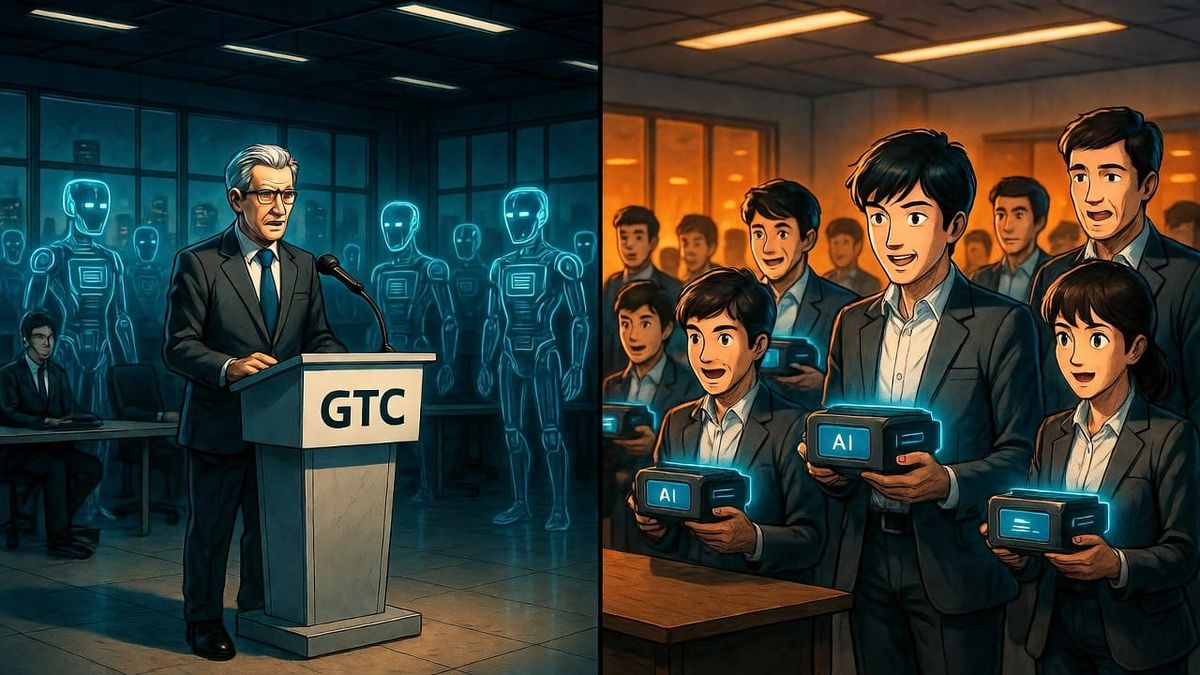
At GTC 2026, Jensen Huang did something unusual for a CEO in the AI space: he told the crowd of tech executives that they were doing it wrong.
Not in those words, exactly. But his message was clear when he said that companies laying off workers to automate tasks with AI agents were, his words, "out of imagination." This from the man who sells the GPUs powering the AI transformation. You might expect him to cheerlead mass automation. Instead, he's warning that the current approach is short-sighted at best, strategically dangerous at worst.
He's not wrong.
The Vision vs. The Reality
When AI promised to transform work, the vision was compelling: tools that could cut workload dramatically for the average worker, giving back precious time and perhaps making a four-day workweek possible. AI as liberator, not replacement.
Two years in, the actual returns on productivity or quality of life for the average worker are still heavily debated. Some companies aren't seeing the expected bump. Tools often hallucinate and require heavy vetting. The productivity gains aren't materializing as promised.
But here's what is happening: in the companies that do see productivity increases from AI, executives eager to maximize profit margins are using those gains as justification to reduce hiring or lay off workers. The AI dividend, such as it is, is being converted entirely into headcount reduction rather than capability expansion.
That's not a productivity revolution. That's cost-cutting with extra steps.
Historical Context: We've Been Here Before
The pattern of employers using new technology to eliminate jobs while promising prosperity is as old as the Industrial Revolution itself. Each wave of automation has followed the same script: productivity increases, workers get displaced, and the promised leisure society never quite arrives for those doing the actual work.
Consider the ATM (Automated Teller Machine). When ATMs were introduced in the 1970s, the conventional wisdom was that bank tellers would be eliminated entirely. The machines could dispense cash 24 hours a day, handle deposits, process transfers. It seemed inevitable. By 1975, American Banker magazine ran headlines predicting the imminent death of the bank teller. Yet by 2010, there were more bank tellers in the United States than there were in 1970. What happened?
The ATMs didn't kill bank teller jobs. They made branch banking cheaper, which led to more branches opening in more locations, which required more tellers to staff them. The tellers who remained shifted from simple cash handling to relationship banking, sales, and complex problem resolution. The technology changed the nature of the work, not the existence of the work.
This historical pattern appears again and again. The power loom didn't eliminate textile workers; it moved workers from hand-weaving to machine operation, eventually creating larger textile industries than existed before. The spreadsheet didn't eliminate accountants; it eliminated the drudgery of manual calculation and opened new areas of financial analysis that weren't previously possible. The combine harvester didn't eliminate farm workers; it moved them off family farms into industrial agricultural operations that employed more people at higher productivity.
In each case, the transition was painful for individuals, but the aggregate economic effect was expansion, not contraction. The workers who adapted, who learned to work with the new technology, generally ended up more productive and better compensated than those who fought the technology directly.
What distinguishes those historical transitions from the current moment? Two things. First, the pace of AI capability improvement is orders of magnitude faster than previous automation waves. The ATM took decades to reach saturation. AI capabilities are doubling on timelines measured in months. Second, the knowledge work that AI is now capable of replacing has historically been the sector that absorbed displaced manufacturing workers. If the automation wave reaches into knowledge work, where does the next generation of workers go?
There is no obvious next sector. The service economy already absorbed the manufacturing workers. The gig economy already absorbed much of the service sector. What remains is a question without a comfortable answer.
The $500,000 Engineer Test
Huang's most provocative comment came in an interview with CNBC's Jim Cramer, where he laid out what I think is actually a brilliant framework for thinking about AI integration.
"Let's say you have a software engineer or an AI researcher, and you pay them $500,000 a year," Huang said. "If that $500,000 engineer did not consume at least $250,000 worth of tokens, I'm going to be deeply alarmed."
This isn't just a productivity metric. It's a measure of AI integration depth. If a knowledge worker at the top of their field isn't heavily leveraging AI tools, one of two things is true: either they haven't been trained and empowered to use AI, or their work genuinely cannot be enhanced by AI. Both are organizational failures.
The first is a training and culture problem. Organizations that haven't equipped their highest-paid people with AI tools are signaling that they don't actually believe in the technology they've been investing in. Either they bought the GPUs and the software licenses without actually changing how work gets done, or they've created an AI adoption culture where the people most capable of leveraging AI are the least likely to be using it because their performance metrics don't reward experimentation.
The second is a strategic problem. If your highest-paid people aren't using AI, you haven't thought hard enough about how AI could transform what they do. A $500,000 engineer who isn't consuming significant AI token volume is either working on problems that genuinely resist AI enhancement, which is worth asking honestly, or they're working in an organizational context that hasn't reimagined what their role could become if AI handled the routine parts.
Token consumption as a metric forces organizations to think about AI as infrastructure, not as a replacement worker. The question stops being "did AI do this task?" and becomes "how deeply is AI integrated into all tasks?" That's a fundamentally different approach than saying "we replaced 30% of headcount with AI."
Force Multiplication, Not Elimination
Huang's vision for AI in the workforce is clear: AI should make every worker more capable, not redundant.
"Every carpenter could now be an architect," he said. "Every plumber will become an architect. I wouldn't be surprised, actually, if the chauffeurs of the future become your mobility assistant and help you do a whole bunch of stuff while the car is driving by itself."
The economic implication here isn't job elimination. It's productivity elevation. If every knowledge worker can now operate at the level that previously required a specialist, the organization becomes fundamentally more capable. The scarcest resource in any organization isn't money or technology. It's the combination of expertise and context that lets good judgment happen.
AI can process. It can generate. It can pattern-match at scale. What it cannot do is replicate the tacit knowledge, institutional memory, and relationship capital that experienced workers carry. The companies getting this wrong are treating AI as a way to do the same work with fewer people. The companies getting it right are asking what new work becomes possible when every worker has an AI capable assistant.
Consider the contrast in approaches. A company that lays off 30% of its workforce and uses AI to cover the gap is essentially borrowing against its institutional knowledge. Those experienced workers carried years of context about customers, products, and organizational dynamics that AI cannot easily replicate. The short-term cost savings may show up in quarterly earnings, but the long-term capability loss often doesn't appear on any balance sheet until years later, when the organization realizes it has lost the ability to execute complex work that requires human judgment.
A company that instead invests in AI tools for its existing workforce, retraining and reorganizing around AI augmentation, is building a different kind of asset. It is building an organization where each worker is capable of more than they could do alone, where the AI handles routine processing while humans focus on judgment, relationship, and creativity.
The distinction matters for another reason: companies that treat AI as a replacement for workers tend to get the worst of both worlds. They lose the institutional knowledge that workers provided, and they often end up with AI tools that require significant human oversight anyway because the tools aren't reliable enough to operate independently. The result is higher cognitive load for remaining workers, more errors from AI hallucinations that go undetected, and a workforce that has been conditioned to distrust the technology that their employer is forcing on them.
The National Security Stakes
Here's the part of Huang's comments that I think is most underappreciated: the national security implications.
"The risk that we run as a nation, our greatest source of national security concern with respect to AI, is other countries adopt this technology while we are so angry at it, or afraid of it, or somehow paranoid of it, that our industries, our society, don't take advantage of AI," Huang said. "So I'm mostly worried about the diffusion of AI in the United States."
The current environment, AI boycotts, data center moratoriums, fear-driven discourse, is not just a cultural phenomenon. It's a competitive liability. If US organizations slow AI adoption while other nations accelerate, the capability gap that emerges isn't just economic. It's strategic.
This isn't hypothetical. China has made AI development a national priority with explicit government backing, coordinated investment, and a workforce development strategy that prioritizes AI skills at every level of education. The European Union is pursuing its own AI strategy with regulatory frameworks designed to encourage adoption within European borders while maintaining some control over how the technology develops. Smaller nations that lack the infrastructure to compete at scale are making bets on specific AI applications where they can compete regardless of size.
The United States currently leads in AI capability, but leadership in technology has never been permanent. The US led in semiconductor design for decades until fabrication shifted to Asia. The US led in consumer electronics manufacturing until those supply chains moved offshore. Leadership in technology requires continuous investment in adoption, workforce development, and infrastructure. Mass layoffs and AI fear-mongering are forms of disinvestment.
This creates a national-level version of the company-level problem: short-term optics versus long-term capability. Every company that uses AI fear-mongering to justify layoffs, or participates in the broader cultural backlash against AI, is contributing to an environment that could hand competitive advantage to less cautious competitors.
Huang's framing is worth sitting with. He isn't worried about AI itself. He's worried about the United States falling behind because Americans are angry at or afraid of the technology. That's a different kind of problem than the technical challenges of AI development. That's a social and cultural problem, and it requires a different kind of response.
The Early Career Pipeline Problem
There's another cost to mass layoffs that rarely gets discussed: the pipeline problem.
Early-career workers in vulnerable sectors are already showing impact from AI displacement. The Irish government has confirmed that AI is starting to show measurable impact in early-career jobs. This isn't just about individual hardship. It's about eroding the pipeline of experienced talent that will be needed to sustain innovation.
Every experienced worker replaced by AI today represents a lost opportunity to develop the experienced workers of tomorrow. Skills are built through doing, with oversight, through years of pattern recognition under the guidance of people who've seen the patterns before. If AI eliminates the entry-level work that trains people, the senior talent pool doesn't just shrink. It essentially stops replenishing.
Think about how expertise develops in any complex field. A junior analyst spends two years processing data, finding patterns, and having those patterns validated or corrected by senior analysts who have seen similar patterns in different contexts. That junior analyst eventually becomes a senior analyst who can recognize patterns that don't fit existing models. That senior analyst then mentors the next generation of junior analysts. The pipeline is sequential and cumulative.
AI disrupts this pipeline at its entry point. If AI handles the routine data processing that junior analysts previously did, those junior analysts don't get the pattern recognition training they need to become senior analysts. The senior analysts of 2035 are the junior analysts of 2025, and if the 2025 junior analysts never get the training, the 2035 senior analyst pool will be dramatically smaller than anyone is planning for.
The math of "do more with less" ignores the replacement rate. Eliminate 30% of early-career positions today, and you don't just lose this year's productivity. You lose 30% of the senior talent pool a decade from now. This isn't a metaphor. It's a demographic reality of how expertise develops.
There's also a second-order effect worth considering. Junior workers don't just do routine tasks. They ask questions that reveal assumptions embedded in how work is done. They challenge established practices because they haven't yet internalized them as "the way things are done." This questioning function is a form of organizational immune system. When you eliminate junior positions, you eliminate the people most likely to notice that the emperor has no clothes.
What Short-Sighted Actually Costs
I've been framing mass layoffs as "short-sighted," but let me be more specific about the actual costs.
Competitive debt. When you lay off experienced workers and replace them with AI tools, you may reduce costs in the short term. But you're also losing the institutional knowledge, relationship capital, and contextual judgment that those workers carried. AI can replicate some cognitive tasks. It cannot replicate the organizational immune system that experienced workers represent. Competitive debt accumulates invisibly and manifests as the inability to execute complex work, the loss of customer relationships built over years, and the erosion of the organizational capability that took decades to build.
Innovation capacity. The research is clear that the most innovative organizations are those where diverse perspectives collide. Mass layoffs homogenize organizations. Everyone left is more similar to everyone else than they were before, because the differences were embodied in the people who left. Innovation requires collision. Collision requires diversity. Mass layoffs reduce diversity.
This isn't abstract. Studies of organizational innovation consistently show that heterogeneous teams produce more novel solutions than homogeneous ones. The homogeneous team optimizes within established parameters. The heterogeneous team challenges the parameters themselves. When you lay off the people who held different perspectives, you are optimizing the organization for convergence rather than divergence, which is the opposite of what innovation requires.
Capability building. As I noted above, if you don't have early-career positions, you don't have senior professionals in 10-15 years. The pipeline isn't just about filling seats. It's about building the expertise that makes organizations capable of doing hard things. The organizations that will thrive in 2035 are the ones building that pipeline today, not the ones that are draining it for short-term cost savings.
Cultural trust. When companies announce layoffs and then their executives talk about AI transformation, their remaining workers notice. The message is clear: "We will replace you when it's convenient." That message doesn't encourage the risk-taking, discretionary effort, and commitment that great organizations require. It encourages quiet quitting in its most literal form, where workers do exactly what is asked and nothing more, knowing that any sign of non-essential contribution is a target for the next round of efficiency improvements.
Cognitive load. There's a well-documented phenomenon in AI-augmented work where the remaining workers end up with higher cognitive load, not lower. They are responsible for overseeing the AI, validating its outputs, and handling the cases the AI cannot handle. If the AI was supposed to make their jobs easier by eliminating the routine work, but the elimination came through headcount reduction rather than process redesign, the remaining workers are now doing the routine work plus the oversight work plus their original job. This is a pattern that shows up consistently in the research on AI adoption in workplace settings.
Addressing the Counterarguments
I want to address the strongest counterarguments to this analysis, because ignoring them would be intellectually dishonest.
Counterargument: "Companies have a fiduciary duty to maximize shareholder value. If AI can do the same work with fewer people, they're obligated to do that."
This argument treats the shareholder as the only stakeholder that matters, and it treats short-term stock price as the only measure of shareholder value. Both premises are questionable. Long-term shareholder value is maximized by companies that maintain their capability to generate future earnings, not just by companies that minimize current costs. A company that eliminates its R&D capability to boost quarterly earnings is not acting in shareholders' long-term interests, even if it appears to be acting in their short-term interests. The same logic applies to workforce capability.
Counterargument: "If we don't lay off workers, our competitors will, and they'll have lower costs and outcompete us."
This is the race-to-the-bottom argument, and it deserves a direct response. If the only viable strategy is to eliminate workers and reduce costs, then every company in the industry ends up with the same strategy, the same reduced capability, and competition reverts to price alone. Industries that compete purely on price tend toward commodity status, low margins, and minimal investment in innovation or quality. The companies that have built durable competitive advantages in their industries are almost universally the ones that invested in capability rather than pursuing short-term cost reduction.
Counterargument: "The workers being laid off can retrain for new jobs. History shows that technology creates more jobs than it destroys."
This is the correct historical pattern, but it comes with important caveats. First, the transition is not costless. Workers who lose their jobs to automation face periods of unemployment, retraining costs, and often geographic relocation. The aggregate gains from technological progress are real, but they don't distribute themselves evenly. Second, the pace of this transition is faster than previous ones. The time available for retraining and transition is shorter. Third, the jobs being created by AI are not obviously accessible to the workers being displaced from knowledge work. Telling a mid-career accountant that they can retrain as an AI prompt engineer is not a realistic career transition plan.
The Framework Worth Using
Huang's challenge to tech executives isn't just moral hand-wringing. It's a strategic critique. And the framework he implicitly offers is worth considering.
The Token Velocity Test. How much of your AI infrastructure is your highest-paid talent actually consuming? If the answer is "not much," that's an organizational failure, not a technology problem. You have invested in AI infrastructure but haven't reorganized work to take advantage of it. Either fix the reorganization or acknowledge that your AI investment is not actually an AI integration strategy.
The Capability Multiplier Question. When you achieve productivity gains with AI, where does that dividend go? Into headcount reduction, or into expanded capability? Both can be rational responses in specific circumstances, but only one builds long-term advantage. If the answer is always headcount reduction, the organization is borrowing against its future capability and calling it a strategy.
The 10-Year Pipeline Check. What percentage of your workforce is in early-career positions? What happens to your senior talent pipeline if AI displaces entry-level work? Are you actively investing in the workforce that will execute your strategy in 2035, or are you consuming that workforce for short-term cost savings?
The Competitive Position Test. Where does your organization stand relative to competitors in your industry on AI adoption? Are you leading, following, or falling behind? If you're following or falling behind, the problem isn't that you're being too aggressive with AI adoption. It's likely that your approach to AI adoption isn't integrated into your business strategy in a coherent way.
These aren't comfortable questions. But they're the questions that separate generational thinking from quarterly thinking.
The Real Choice
Huang's message at GTC was essentially this: you can use AI to do the same things with fewer people, or you can use AI to do fundamentally more ambitious things with the same people.
The first option is comfortable. It shows up in quarterly earnings. It makes the stock price move in the right direction. It's easy to explain to analysts who are evaluating your company on near-term financial metrics. Every cost reduction flows directly to the bottom line in a way that is measurable and attributable.
The second option is harder. It requires imagination (his word, not mine). It requires investing in training, in tooling, in rethinking what work could look like. It requires accepting that the productivity gains from AI will show up slowly and incrementally rather than all at once in headcount reduction. It doesn't always show up in quarterly earnings, at least not immediately. And it requires executives to explain a more complex narrative to analysts who may not want to hear about multi-year capability building when they are focused on next quarter's numbers.
But it's the only option that builds rather than borrows. The only option that creates rather than extracts. The only option that treats AI as what it actually is: a profound capability multiplier, not a replacement worker.
The companies that figure that out, the ones with the imagination Huang is calling for, will be the ones that look back at this moment as the turning point. They will have used the AI transition to build organizations that are fundamentally more capable than their competitors, with workforces that have developed new skills rather than having been made obsolete. They will have invested in the pipeline rather than consuming it.
The ones that got it wrong will be the cautionary tales. They will have optimized their way into organizations that can execute today's strategy competently but cannot generate tomorrow's. They will have reduced costs in ways that felt like wins in the short term and revealed themselves as strategic errors in the medium term. And they will have contributed to a national capability gap that hands competitive advantage to the countries that were less afraid of the technology.
The choice is genuinely this stark. The question is whether the executives making these decisions have the imagination to see it.