The Advice We Give Our Kids Is Already Obsolete
Be a doctor. Be a lawyer. Learn to code. Every piece of career advice we inherited is being dismantled by AI. A father's look at why the 4-year degree model can't survive what's coming.

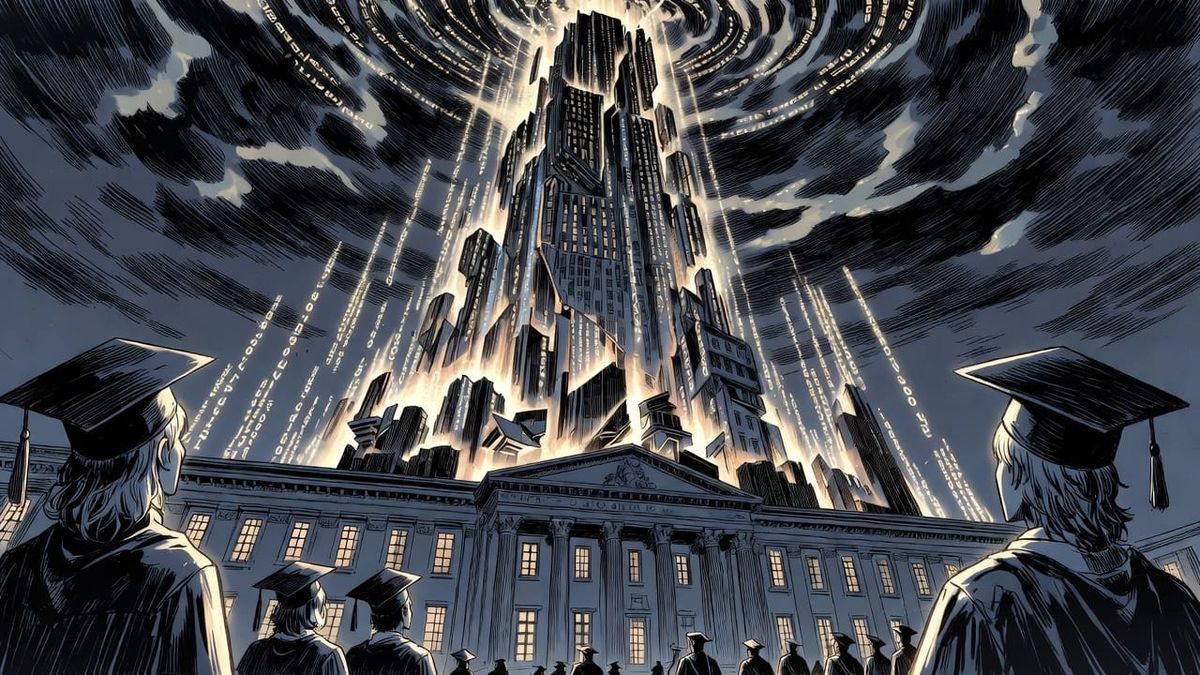
Be a doctor. Be a lawyer. Learn to code.
That's the advice chain most of us inherited. Study hard in school, go to college, pick a respectable career, work for 40 years, retire. Each generation handed it down like gospel.
I'm a father, and I can't hand that chain down anymore. Not honestly. Because AI is dismantling every link in it, and I'd rather tell my kids the truth than repeat comfortable advice that stopped being true.
The Careers We Were Told to Chase
Let's walk through the script.
"Be a lawyer." London-based law firm A&O Shearman built an AI tool that scanned 20 years of license agreements, whittled 2,400 regulatory requirements down to 900, and halved the project cost. One lawyer with AI now does what previously required several. Venture capitalists are warning that entry-level legal work -- the research and drafting that junior associates cut their teeth on -- is being automated first.
"Go into finance." JPMorgan's managers have been told to avoid hiring as the firm deploys AI across its businesses. Goldman Sachs is reorganizing its people "front-to-back." And in the most revealing move yet, OpenAI hired 100+ former investment bankers at $150/hour to train AI on building financial models -- with the explicit aim of replacing the entry-level work those bankers once did.
Read that again. The people who spent years getting the credentials and landing the jobs are now being paid to make their own positions obsolete.
"Learn to code." Google reports that 25% of its new code is AI-generated. Microsoft is at 20-30% and projects 95% by 2030. By the end of 2025, 85% of developers regularly use AI coding tools. The Bureau of Labor Statistics still projects software jobs growing 17.9% through 2033, but there's a catch: companies aren't hiring juniors for the simple tasks AI now handles. Total programming job offers rose 68% in H1 2025, but junior-level offers increased by only 20%.
The advice "learn to code" isn't wrong exactly. But telling someone to learn to code so they can get a coding job is increasingly misleading.
The Scale of What's Coming
This isn't about individual professions. It's structural.
Microsoft's 2025 data shows 5 million white-collar jobs facing extinction, with 38% of white-collar roles projected to be replaced or substantially transformed by 2026. Ford CEO Jim Farley warned that AI will "replace literally half of all white-collar workers." Salesforce CEO Marc Benioff says AI is already handling up to 50% of the company's workload.
The Axios report is the one that sticks with me: "Every single" CEO they spoke with across industries is working to figure out when and how AI can displace human workers at scale. And yet, "hardly anyone is paying attention."
Meanwhile, 61% of white-collar workers themselves expect AI will replace their current role within three years. They see it coming. They just don't know what to do about it.
This is the world we're sending kids into after 4-8 years of college.
The 4+12 Problem
In my companion piece on K-12 education, I wrote about the 16,000 hours of K-12 inefficiency. College compounds that problem.
After 12 years of K-12, we ask students to add 4 to 8 more years of increasingly expensive education. Medical school and residency can push the total past 20 years of formal education. Law school adds three. An MBA adds two.
The math is absurd when you measure it against how fast the market moves. By the time a medical student finishes residency, the AI landscape will have changed multiple times over. The skills learned in year one of a computer science degree may be irrelevant by graduation. The career you're training for might not exist in its current form by the time you're licensed to practice it.
And the cost keeps climbing. Student loan debt stands at $1.84 trillion, with the average graduate owing $29,300. The price of college has more than doubled in four decades. New federal repayment rules starting in 2026 extend the pain: borrowers will make payments for up to 30 years, crowding out savings, homeownership, and family formation.
For students who enroll but never finish -- and many don't -- the debt stays while the income transformation never arrives. That risk has become increasingly untenable.
The ROI Myth (and Reality)
Now, I'm going to be honest about the data, even where it complicates my argument.
College still pays off for most graduates on average. FREOPP's analysis puts the median bachelor's ROI at $160,000. Brookings notes that degree holders outearn non-completers by an average of $8,000 a year even after accounting for debt. The college wage premium grows from 27% at age 25 to 60% at age 55.
But that median hides a wide range. Engineering, computer science, and nursing degrees can pay off by $500,000 or more. Meanwhile, nearly half of master's programs leave students financially worse off. An analysis of 175 New England colleges found that about 15% of programs didn't yield net gains.
Here's the kicker: certificates in technical trades have a higher payoff than the typical bachelor's degree.
The question isn't "is college worth it?" The question is "which college, which major, at what cost, and does the timeline still make sense when AI is reshaping the careers at the other end?"
For a growing number of students, the answer is no.
The Credential Shift That's Real (and the One That Isn't)
There's a popular narrative that companies are dropping degree requirements. The headlines are encouraging: 53% of employers have removed degree requirements, a 30% increase from 2024. Companies like Apple, IBM, Google, and Walmart have publicly committed to skills-based hiring.
But Harvard's research reveals the gap between announcement and reality. Fewer than 1 in 700 hires are truly made on a skills-only basis. Of the companies studied, 45% saw no measurable change in actual hiring after removing requirements. Another 18% reverted to credential bias.
The credential system is dying in theory but alive in practice. Which creates a trap: the degree might not be on the job posting, but the hiring manager still expects it.
Still, the direction is clear. McKinsey found that hiring for skills is 5x more predictive of job performance than hiring based on education. Companies that actually follow through see 91% reduction in time-to-hire and 25% better retention after two years. The economics favor competency over credentials -- it's just taking the culture longer to catch up.
Micro-Credentials and the Compression of Time
While traditional institutions debate, the market is building alternatives.
Micro-credentials break even in 14 months versus 3-5 years for a traditional degree. The US now has 1.85 million unique credentials from over 134,000 providers. Seventy-four percent of employers prefer candidates with verified digital skills credentials for AI-related roles over traditional degrees alone.
Stanford found that 62% of universities now run micro-credential pathways connected to industry competency models. Even the institutions know the static four-year curriculum can't keep pace. When a new AI framework launches in January, a micro-credential course is available by March. A university curriculum update takes years.
The question isn't whether credentials are changing. It's whether the change is fast enough for the kids entering the system right now.
The Demographic Cliff Adds Urgency
The economics of higher education face their own existential threat. The long-predicted demographic cliff has arrived. The number of 18-year-old high school graduates peaked in 2025, and a 15-year decline follows. By 2041, the traditional college-age population will be down 13%.
Over 120 colleges have closed or merged since 2016. A Federal Reserve Bank of Philadelphia model predicts up to 80 more could close by 2029, doubling the current annual closure rate. Small, tuition-dependent institutions in the Midwest and Northeast are most vulnerable.
The "second cliff" is even more troubling. Updated Census projections show the 18-year-old population briefly rebounding around 2033 before declining again -- and not exceeding 4 million for the remainder of the century. This isn't cyclical. It's structural.
Colleges that can't adapt will close. The ones that survive will look fundamentally different from what we grew up with.
What I Tell My Kids
I'm not telling my kids to skip college. I'm telling them to think about it differently than I did.
The degree itself is not the goal. The ability to learn, adapt, and demonstrate competency is the goal. If a degree is the best path to that for a specific career -- and for some careers it genuinely is -- then get the degree. But go in with eyes open about the cost, the timeline, and the likelihood that the career landscape will shift before the diploma arrives.
I'm telling them that AI tool proficiency isn't a nice-to-have. It's the new literacy. The World Economic Forum says 39% of existing skills will be transformed or obsolete by 2030. That means continuous learning isn't motivational poster language. It's survival.
I'm telling them that the people who thrive won't be the ones with the most impressive credentials. They'll be the ones who can learn fastest, adapt quickest, and combine human judgment with AI capability. As one CIO put it in TechTarget's 2026 report: the question has shifted from "where did you study" to "how fast can you learn."
And I'm being honest that I don't have it all figured out. Nobody does. The traditional advice chain -- study, degree, career, retire -- was built for a stable world. We don't live in that world anymore. The best I can do is teach my kids to see clearly, think critically, and never assume that today's path will still exist tomorrow.
The 4-year degree model isn't dead yet. But it's on borrowed time, and the clock is AI.
Found This Helpful?
This post is a companion to "What Are We Even Preparing Our Kids For?" -- a look at the K-12 side of this equation. If you're a parent, educator, or anyone questioning the traditional education-to-career pipeline, consider subscribing for more research-backed perspectives on AI, education, and the future of work.
Sources
College Value and ROI
- College ROI in 2025: Rethinking Value
- Does College Pay Off? Comprehensive ROI Analysis (FREOPP)
- College is Still Worth It, But We Can Do Better (Brookings)
- College Degree ROI (EducationData.org)
AI and White-Collar Job Displacement
- How AI Is Changing White-Collar Work (TIME)
- AI Already Taking White-Collar Jobs (CNBC)
- AI Replacing 38% of White-Collar Jobs by 2026
- AI Sleepwalking Into White-Collar Bloodbath (Axios)
- 61% of Workers Expect AI Replacement in 3 Years (Fortune)
AI and Coding
- Generative Coding: 2026 Breakthrough Technology (MIT Technology Review)
- AI-Generated Code Statistics 2026
Skills-Based Hiring
- State of Skills-Based Hiring in 2025 (TestGorilla / Interview Guys)
- Harvard Research: The College Degree Gap
- Rise of Skills-Based Hiring: Why Degrees Matter Less (Madison Approach)
Micro-Credentials and Alternative Education
- Micro-Credentials vs Degrees 2026 (EditorialGE)
- 1.85 Million Credentials in the US (Credential Engine)
- Top 5 Digital Credentialing Trends in 2026