The Death of Top-Down Leadership: Teams Over Bosses
68% of employees cite coworkers—not managers—as their primary source of inspiration. This isn't about team building. It's evidence that hierarchical leadership models no longer match how modern knowledge work actually happens.

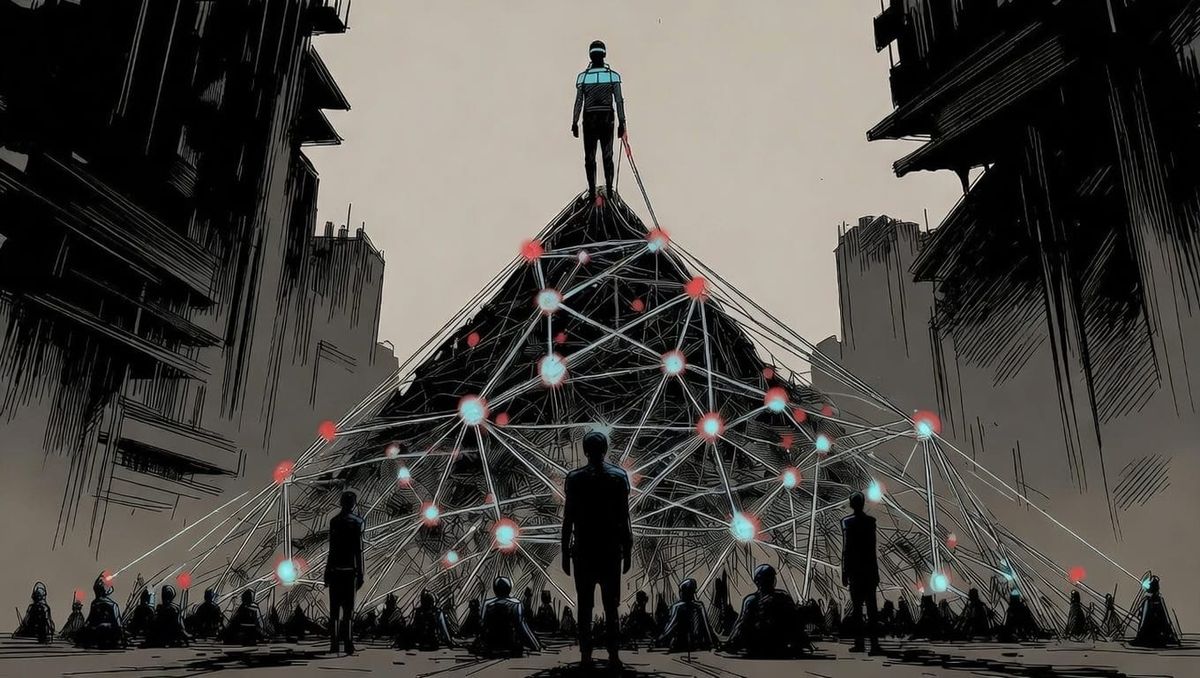
The data is unambiguous: hierarchical leadership models no longer match how modern knowledge work actually happens. When the majority of workplace inspiration flows horizontally through peer networks rather than vertically through management chains, we're not looking at a "culture problem."
We're witnessing the structural incompatibility between 20th-century organizational design and 21st-century work reality.
Leadership isn't dying. Top-down, command-and-control hierarchy is.
The Hierarchy Doom Loop
The O.C. Tanner 2026 Global Culture Report revealed something organizations don't want to hear: 68% of employees identify coworkers—not their managers—as their primary source of workplace inspiration. Peer relationships matter more than reporting relationships.
Think about your last breakthrough moment at work. Where did the insight come from? If you're honest, it wasn't from your 1:1 with your manager. It was from grabbing coffee with a peer, or a Slack message from someone two desks over, or a question that sparked during a team brainstorm. That's not anecdotal—it's the default state of knowledge work now. The moment someone needs context, multiple perspectives, or creative problem-solving, they go horizontal before going up.
Meanwhile, 71% of leaders report significantly higher stress since stepping into their current roles. Forty percent have considered leaving leadership positions entirely to improve their wellbeing. These aren't people burned out from hard work—they're burned out from an impossible structural position.
Here's why: hierarchical structures ask leaders to be decision-makers, quality-gatekeepers, performance judges, conflict mediators, and inspiration sources simultaneously. In a knowledge work context where information moves at digital speed and complexity exceeds any single person's expertise, this role becomes impossible. You can't make good decisions when you don't have all the information. You can't be the inspiration source when most inspiration flows peer-to-peer. You can't be the gatekeeper when the work is too technical for your level of detail.
Here's the connection: burnt-out leaders are 50% as likely to be engaged in their roles. When organizations push for harder accountability without support, leaders fall back into command-and-control behavior. They tighten reporting requirements, demand more approval chains, and micromanage because hierarchy is the only lever they have. Research shows this drives burnout rates upward significantly, creating a doom loop where hierarchy stress reinforces hierarchy behavior.
This is the death spiral:
- Hierarchy creates stress on leaders
- Stressed leaders revert to control
- Control kills intrinsic motivation in teams
- Lower engagement creates performance pressure
- Pressure reinforces the need for hierarchy
- Loop repeats until burnout
AI Is Exposing the Hollow Layer
The narrative is "AI will replace middle managers." The reality is more uncomfortable: AI is revealing that middle management was already hollow.
Consider what a typical middle manager does:
- Status coordination - What's your team working on? What's blocking them? AI can pull this from project management systems and generate updates automatically.
- Cross-functional scheduling - Finding meeting times when four people are free. AI can do this in milliseconds.
- Workflow handoff management - Making sure output from team A feeds input to team B at the right time. AI can monitor this continuously.
- Performance data aggregation - Collecting quarterly metrics from six team members to report upward. AI can track this in real-time.
- Escalation management - Deciding which problems go up and which stay at the team level. AI can flag exceptions.
What's the common thread? None of these tasks require human judgment, contextual understanding, or relationship management. They require consistency and speed.
Organizations adopting AI report up to 25% reductions in middle management layers. But AI isn't replacing managers—it's exposing work that should never have been human work in the first place. When you automate the coordination work, what's left is... not much. At least not in traditional hierarchical structures.
The managers who survive aren't the ones who coordinate—they're what we might call Insight Architects: people who look at AI-generated data and ask "So what?"—providing human context AI can't. Why are engagement metrics declining in team X? What's the hiring market telling us about compensation competitiveness? How does this technical decision affect our customer relationships? These require judgment, wisdom, and contextual thinking.
But here's the problem: 82% of boards and CEOs plan to reduce workforces by up to 20% in the next three years because of AI. Middle management is the target. Not because AI can do their job, but because their job was never supposed to exist at this scale. The coordination layer was built to connect information across growing organizations before digital tools existed. Now that digital tools (and AI) can do that work, the structural need for that layer disappears.
The real transition: From "managers who coordinate" to "leaders who contextualize."
The Problem Isn't Hierarchy—It's Invisible Power
Before celebrating the death of hierarchy, let's look at why flat organizations fail. And they do fail—spectacularly.
Google tried it with 400 employees. It lasted months. Without formal structure:
- People went directly to Larry Page with expense reports
- Interpersonal conflicts had no resolution path
- Decision authority was undefined—no one knew who could actually approve spending
- Manager overload became unbearable as people searched for someone to make a decision
- The organization became a free-for-all with invisible power accumulating around whoever was loudest or closest to executives
Google learned the lesson: Eliminating formal hierarchy doesn't eliminate hierarchy. It just makes it invisible.
Zappos provides the interesting contrast. They didn't try to eliminate structure—Tony Hsieh saw that productivity per employee was decreasing as the organization grew past 1,500 employees. Rather than pile on more managers, they implemented Holacracy: a framework that replaces job titles with role assignments while maintaining explicit, visible accountability.
The key difference: Accountable structure vs. invisible hierarchy.
When you remove formal hierarchy without replacing it with clear accountability, you get something worse: informal hierarchies that are darker because they're hidden. The natural human tendency is to organize—to find authority figures, create status hierarchies, develop in-groups and out-groups. In a "flat" organization with no official structure, these dynamics still emerge, but now they're opaque:
- Cliques form around hidden influence (who has drinks with the CEO?)
- Favoritism flourishes invisibly (whose ideas get promoted?)
- Decision authority becomes unclear (wait, does he have the power to approve this?)
- Status games become more vicious because power is hidden
A 10-person team can operate flat. Everyone can talk to everyone; power dynamics are visible; decisions happen naturally because the group can convene instantly.
A 50-person team starts showing strain. Some people never talk to some other people. Decision-making slows because you can't always get the right 8 people in a room.
A 200-person team without structure is chaotic. You have invisible gatekeepers controlling information flow. You have politics you can't see. You have some people with decision authority who shouldn't have it, and others without authority who should.
Zappos worked at 1,500-2,000 because they made invisible power visible—every decision authority was explicit, every role was clear, every accountability was transparent. That's not the same as flat. It's structured flatness.
The debate isn't "hierarchy vs. flat." It's "What's the minimum viable coordination structure for your scale, and are we being honest about who actually has power?"
Why Peer Networks Outperform Hierarchies
Here's what organizations miss when clinging to top-down models: Peer relationships are already doing the leadership work. The question is whether you're going to acknowledge it and optimize for it, or keep pretending your org chart matters.
A meta-analysis across 73 independent samples with over 21,000 employees shows coworker support strongly correlates with workplace thriving and performance. This isn't just happiness—it's hard performance metrics. People with strong peer support deliver better work.
Additionally, a separate meta-analysis of nearly 78,000 employees confirms coworker support significantly impacts role perceptions, attitudes, and effectiveness. That's 78,000 data points saying the same thing: peer relationships drive performance.
When 64% of employees generate new ideas during conversations with colleagues, you're not looking at "collaboration"—you're looking at horizontal information flow becoming the primary productivity mechanism. Your org chart says ideas flow from leaders down to teams. Your data says ideas flow peer-to-peer.
Network effects in human organizations:
- Horizontal information flows faster than vertical - A peer can give you context in 10 minutes that would take your manager an hour to source. Peers know the actual state of things; managers know the reported state.
- Peer validation carries more weight than managerial approval for knowledge workers - When you're solving complex problems, you trust the judgment of people who understand the domain as deeply as you do. That's almost never your manager.
- Collective problem-solving beats individual expertise in complex, ambiguous domains - Your manager knows their domain well. But they don't know what you know. Three peers talking through a problem generate better solutions than one expert deciding.
- Inspiration spreads laterally, not top-down - Seeing your peer accomplish something hard is more motivating than your manager telling you to accomplish something hard. One is "someone like me figured it out" and the other is "the person with authority wants me to do something."
Why does this matter now? Work itself has changed fundamentally.
- Complexity increased: No single person has all the context anymore. When your job requires knowing customer needs, product capabilities, technical constraints, business strategy, and team dynamics—no manager can be your primary information source. Peers become the network. Your job is connecting with them.
- Change accelerated: Hierarchical approval chains take weeks. Your market moves in days. By the time your manager approves your approach, the competitive landscape has shifted. You need peer input fast, not hierarchical validation later.
- Trust localized: People trust their immediate peers more than distant executives. This isn't cynicism—it's rational. Your peer works in the same context you do, faces the same constraints, understands the constraints, has skin in the same game. Your C-suite executive operates in a completely different context.
- AI flattened expertise: When everyone has access to Claude, ChatGPT, or Gemini, your manager's information advantage disappears. What remains is judgment, and judgment is distributed across the organization. Your peer's judgment might be better than your manager's for your specific problem.
The evidence is clearest in tech: 78% engagement—the highest of all sectors—despite famously high burnout and hours. Tech isn't succeeding at culture; tech is succeeding despite hierarchical pressure. The high engagement comes from strong peer relationships, well-defined culture that doesn't require manager enforcement, and technical work that's inherently interesting. Not from good management.
This is the disconnect most organizations miss: Tech companies have the strongest peer networks, which generate the highest engagement, so executives think "see, our hierarchy works!" No. Your peer relationships work despite your hierarchy. When tech companies force return-to-office mandates, they're betting against their own engagement data—reasserting top-down control when peer relationships drive inspiration and engagement, not physical proximity.
The Leadership Crisis: AI Fear and Delegation Failure
Here's where this gets dangerous: Frontline managers are 3X more likely to have concerns about AI impact compared to senior leaders.
Why? Because senior leaders see AI as a productivity multiplier. They sit in meetings discussing "how we'll be more efficient with AI" and watch metrics improve. Frontline managers see something different—the work they used to do is automatable. The coordination they used to provide is now AI-driven. The status reports they used to file are now auto-generated.
They're watching their job get hollowed out in real-time.
Meanwhile, only 25% of workers receive formal AI training despite saving hours daily with AI tools. Nobody's teaching frontline managers how to transition their role. Nobody's explaining that the coordination work wasn't the point—the contextual judgment was. Instead, they're watching leadership celebrate efficiency gains and wondering when the layoffs come.
Most tech workers expect significant role changes from AI in 2026. But they're not being prepared for those changes. They're being told "AI will make you more productive" while their manager's anxiety leaks into every meeting.
This creates a trust chasm: The people actually doing the work don't trust the people making AI decisions because those decisions aren't being explained transparently. Distributed leadership matters MORE in AI adoption, not less, because buy-in has to come from the ground up.
Here's what that means: Your VP of Engineering can't mandate AI adoption. Your director can't force it to work. It has to be peer-to-peer adoption where frontline people say "yes, this tool makes my work better." But that can only happen if they trust that leadership isn't using AI as a backdoor to squeeze them. That trust breaks down in hierarchical organizations where information flows top-down and employees can't see the real reasoning.
Then there's the skill gap. Delegation is not what most managers think it is. They think delegation is "giving someone a task." Real delegation is:
- Trusting someone with decision-making authority (not just task completion)
- Making yourself available when they need context
- Letting them own both success and failure
- Shifting your role from "doing the work" to "enabling others to do the work"
Delegation is 5X more impactful than other leadership behaviors for burnout prevention—yet only 19% of rising leaders have strong delegation skills. We're promoting people into leadership without teaching them the ONE skill that prevents burnout. We're promoting people who are good at doing work into roles that require enabling others to do work. Then we're surprised when they burn out.
This isn't a training gap. It's a philosophy gap. Hierarchical organizations reward people who "do more." Someone who takes on extra projects, works late, ships features gets promoted. Then we promote them into leadership roles and expect them to suddenly change their behavior—to enable others instead of doing it themselves. But the organization is still rewarding "do more," so they keep doing it. And they burn out.
The fix requires organizational change, not training: Reward managers for enabling team growth, not for personal output. Make that the promotion criterion. Make that the performance metric. Then delegation becomes rational instead of counterintuitive.
The Transition Trap: Why Most Reorganizations Fail
Here's the critical mistake organizations make: They flatten the org chart without flattening the culture.
You keep the same performance metrics (individual achievement, not team outcomes). You remove the manager layer but don't change what people are rewarded for. You say "now you're empowered" without actually giving people decision authority. You create confusion instead of freedom.
Reorganizations fail because they change structure without changing incentives. When you remove a management layer but don't change who controls budgets, who decides hiring, who approves major decisions, you haven't flattened anything. You've just eliminated the middle people while keeping the control.
Real flattening requires:
Change compensation - Move from individual performance bonuses to team/domain bonuses. When your paycheck depends on your peers succeeding, you help them.
Change budgeting - Instead of "managers control team budgets," move to "teams propose budgets based on capacity and strategic priority." This means finance becomes advisory, not gatekeeping.
Change decision authority - Be explicit about who decides what. Don't say "everyone has input." Say "engineering lead decides technical approach," "product decides features," "business owner decides go/no-go." Explicit beats vague every time.
Change communication - Information shouldn't require manager approval to share. If team A needs to know something, they should be able to ask team B directly. This means removing the "run it by your manager first" norm.
Change evaluation - Don't evaluate people on "how much they accomplished." Evaluate them on "how well they enabled others to accomplish more." For managers especially, make enabling growth the primary metric.
Change transparency - Distributed leadership only works if everyone can see decisions being made. Share salary bands. Show how budgets are allocated. Publish decision logs. Invisible power will emerge if you don't make everything visible.
One company did this well: They flattened to autonomous teams, then explicitly changed their eval rubric. Within 6 months, behavior changed. People who used to hoard information started mentoring. People who used to do everything started delegating. The structure enabled it, but the incentives locked it in.
What Actually Works: Distributed Leadership With Clear Accountability
The solution isn't zero hierarchy. It's less hierarchy with visible accountability.
Organizations that are getting this right have specific structural characteristics. Let's talk about what they're actually doing:
Distributed autonomous units - Small teams (6-12 people) with decision-making authority based on expertise, not title. A team owns a domain and makes decisions about that domain without waiting for approval. There's a "lead" but that's a role, not a rank—the lead is accountable for outcomes, but authority to decide technical approach, team composition, tools, and process lives with the team. If a decision affects another team, those teams collaborate. If it affects the business, the business stakeholder sits in the conversation. But there's no hierarchical veto.
Algorithmic coordination - This is the critical infrastructure people miss. AI isn't replacing managers; it's replacing coordination meetings. When 8 engineers need to sync on progress, they don't meet weekly with a manager who summarizes. They each update a system (Jira, Linear, whatever), AI synthesizes the status across teams, and people only talk if there's an actual dependency or blocker. Scheduling becomes calendar-to-calendar automatic. Resource allocation becomes predictive (this team is 60% booked next sprint, we need to balance). This frees humans to focus on judgment and context.
Peer-led initiatives - Rather than leadership deciding what gets worked on and assigning it, teams propose work. If multiple teams see a problem (tech debt, tooling, process), they can self-organize to solve it. One person from each affected team joins a working group. They propose a solution. It gets implemented. This sounds chaotic, but organizations implementing this report higher autonomy, faster problem-solving, and increased retention because people feel agency.
Network structures - Information doesn't need to flow up-then-down. If team A needs context from team B, A talks to B directly. This means removing the norm of "let's include everyone's manager" on emails. It means allowing teams to directly commit to shared goals without hierarchical negotiation. It means documenting decisions in places where affected teams will see them, not in manager notes.
Shared responsibility model - Leadership responsibility is distributed based on expertise and situation. The most senior engineer in a codebase drives architecture decisions. The person closest to customer needs drives product direction. The person running hiring drives talent decisions. But none of these people have authority over the others. They operate more like a board making decisions together than a hierarchy where one person decides.
Real example: A company we know operates with zero director-level engineering positions. Engineers are organized by domain (payments, auth, core, etc.). Each domain has a "tech lead"—usually the most experienced engineer in that domain. That person doesn't manage anyone; they don't do performance reviews; they don't set salaries. What they do is:
- Drive architecture decisions and defend them
- Mentor junior engineers in their domain
- Be the "point person" when other teams need something from their domain
- Propose hiring in their area based on capacity and skill gaps
For strategy-level decisions (hiring freeze, pivot priorities), there's a leadership meeting. Everyone in it has equal voting power, regardless of title. No vetoes.
For day-to-day work, teams self-organize. For blocking problems, the relevant domain leads talk. For company direction, the group decides. No single point of failure, but also no ambiguity about who decides what.
The new management archetypes:
The managers who survive and thrive aren't coordinators. They transform into three roles:
- Insight Architects - They look at AI-generated data and ask "So what?" When AI says "engagement metrics are declining in team X," the Insight Architect investigates: Is this burnout? Skill mismatch? A specific person? A project? They provide human judgment that AI can't.
- Talent Gardeners - They create conditions for peer-led growth instead of managing individual contributors. They make sure peer coaching happens. They connect people for mentorship. They notice when someone's struggling and connects them with support. They're less "manager" and more "facilitator of growth."
- Accountability Anchors - In distributed systems, power can become invisible. These people make accountability explicit. Who owns this decision? What happens if we fail? How do we handle conflicts between teams? They maintain the governance layer without being authoritarian about it.
For Organizations: Stop forcing top-down mandates when most workers want hybrid. Invest in peer coaching infrastructure instead of leadership development programs. When coworkers are the primary inspiration source, give them tools and time to coach each other. Redesign manager roles around providing human context AI lacks. Kill coordination work—if AI can do it, don't ask humans to do it. Map your informal hierarchies and make invisible power visible before it becomes toxic.
For Leaders: Learn delegation or burn out. Few leaders have this skill; it's the #1 burnout preventer. Stop trying to be the primary inspiration—most employees are inspired by peers, not managers. Enable peer relationships instead of competing with them. Make your authority visible and temporary. In distributed models, authority should be explicit, limited, and situation-dependent. Ask "So what?" instead of "What?"—AI tells you what's happening; your job is providing context and meaning.
For Individuals: Invest in peer relationships—they're your primary career asset in flat structures. Build self-management skills because no one's going to tell you what to do anymore. Seek peer coaching, not manager approval. Exercise leadership without title. Distributed leadership means everyone leads. Prepare for role changes—most tech workers expect significant changes in 2026. Be ready.
The Question Isn't Whether—It's When and Who Pays the Price
By 2030, most organizations expect fewer leadership layers. But the flattening isn't coming—it's already here. Organizations treating this as a "future trend" are already behind. Their best people are already gone. They just haven't noticed the turnover spike in the data yet.
This shift represents a fundamental change in how we think about organizational structure itself, and the stakes are massive:
Traditional hierarchy assumes:
- Information flows top-down
- Leaders have answers
- Coordination happens through approval chains
- Control enables success
- Centralization = stability
Network structures assume:
- Information flows peer-to-peer
- Intelligence is distributed
- Coordination happens through alignment
- Autonomy enables success
- Distributed power = resilience
The difference isn't theoretical. It's the difference between:
- Burnout vs. engagement
- Exodus vs. retention
- Slow decision-making vs. rapid iteration
- Fear of change vs. driving change
- Surviving disruption vs. leading it
The 68% coworker-inspiration stat isn't just a data point. It's evidence that humans naturally organize as networks, not hierarchies. Put a group of humans in a room without structure, and they'll form peer networks, not hierarchies. Hierarchies require sustained effort to maintain because they're fighting human nature.
When you force network creatures into hierarchical structures, you get psychological friction. People spend energy navigating the hierarchy instead of solving problems. Information gets lost in translation up and down chains. Trust gets strained because informal power contradicts formal authority. Burnout compounds because the system is exhausting to maintain.
When you enable network structures with clear accountability, you get:
- Faster problem-solving - Peers solve problems directly instead of escalating
- Higher engagement - People feel agency and trust the system
- Better retention - Burnout drops because coordination isn't eating 40% of people's time
- Peer-driven innovation - Ideas spread horizontally, not vertically
- Natural resilience - No single point of failure
The death of top-down leadership isn't the death of leadership itself. It's the birth of something better. Organizations that recognize peer intelligence as their primary asset—not a threat to hierarchy—will thrive. Those clinging to command-and-control will lose their best people to burnout, frustration, or better opportunities at companies that get this.
The timeline is compressed. Companies aren't gradually flattening over a decade. They're doing it in 2-3 years because:
- AI is forcing the transition (middle management gets eliminated whether you plan it or not)
- Talent market is forcing it (people will leave for flat organizations)
- Speed is forcing it (hierarchical org can't move fast enough)
If you're still operating with 7 layers of management, you're in trouble. Not in 2030—right now.
The question isn't whether hierarchy is dying. The question is whether your organization will lead the transition or be disrupted by it.
If you lead it: You'll retain talent, move fast, and adapt to disruption. If you get disrupted: You'll lose your best people to competitors who flattened, then panic-reorganize, then do it badly because you're behind.
Found This Helpful?
The Intelligence Adjacent framework is free and open source. Want to dig deeper into distributed leadership practices? Join as a free Lurker for methodology guides, or become a Contributor ($5/mo) for implementation deep dives.
Sources
Research & Data
- O.C. Tanner 2026 Global Culture Report
- DDI Global Leadership Forecast 2025
- Meta-Analysis of Coworker Effects
- Administrative Science Quarterly: Peer Influence in the Workplace
Organizational Design
- MIT Sloan: Why Distributed Leadership is the Future
- TechTarget: The Great Flattening
- Lighthouse: Your Flat Organizational Structure - 5 Reasons it Will Fail
- Enlivening Edge: What's Going On with Employee Empowerment?
AI Impact & Leadership
- Forrester: Predictions 2026 - Tech Leadership
- Korn Ferry: HR Trends to Watch in 2026
- Fast Company: How AI Is Killing (and Reinventing) Middle Management
- DDI: Delegation and Burnout Prevention
- Gallup: Manager Support Drives Employee AI Adoption
- How AI Is Reshaping Organizational Design Globally
Culture & Trends
- O.C. Tanner: 5 Company Culture Trends for 2026
- Inc.com: Command and Control Leadership Is Dead
- Center for Leadership Studies: Leadership Trends That Will Dominate in 2026
- Kleine et al. (2019): Thriving at Work Meta-Analysis